Wednesday, May 30, 2012

Oh the Humanities!: Of Language Czars, the Civil Service and Policy-Making

A story about my research being presented today at the Congress of the Humanities and Social Sciences in Waterloo appears in today's National Post.  I wanted to get this post up quickly because it clarifies a few points - and spins my research a little differently from how the Post did.

The article is connected to my ongoing research on the history of bilingualism, and the ways in which English-speaking Canadians responded to efforts to promote second-language learning and individual bilingualism since the 1960s.  My paper at Congress is entitled "Playing Games with the Language Czar: The Peculiar Political Role of the Commissioner of Official Languages".  It details a number of the initiatives undertaken the first Commissioners, starting with Keith Spicer, to foster positive attitudes to language learning and bilingualism in Canada, including the development of board games such as "Oh! Canada" and "Explorations", and sponsorship of Canadian Parents for French.  I discuss how the Commissioners went beyond the somewhat negative legislatively-required dimensions of their roles -  such as investigating complaints about delivery of service in both official languages - to undertake initiatives to promote more positive attitudes towards Canada's official languages, and towards language learning more generally in Canada.  As the Commissioners argued, this was in line with the spirit of the Act, and enhanced the acceptability of the official languages policy with Canadians, and their actions were on the whole supported by the governments of the day.

Although the National Post reporter chose to spin this aspect in a more negative way than I might have liked, I argue that the ability of the Commissioners to engage in these creative activities was part of a more open approach to public policy making that was part of Canada's political culture of the 1960s and 1970s (and earlier), when senior civil servants and officers of Parliament were encouraged and allowed to play a more active role in the process of policy development, and to draw on their skills and creativity to propose and build upon policy directions that the governments of the day wanted to undertake.  I view the loss of this in the present day as a detriment to Canadian society, and a sign that the federal government is acting in increasingly ideological ways, and seems afraid to trust the expertise of the people who work for it.  These Commissioners, and other officers of Parliament, were acting in what they interpreted to be the best interests of Canadians, in line with the spirit (if not necessarily the more specific - but not restrictive -  wording) of the legislation that created their officers.  Contrary to what I interpret to be the position of the National Post, I don't view this as troubling, but as an often important external check on the actions of our governments or an enhancement to the policy-making process.  

I'll have more to write later, but my presentation itself is today, and I have to go a-Congressing!

ETA: Also, although the Oh! Canada game mentioned in the article was released in 1974, I wasn't actually playing it until several years later - what with not being born until 1977! - which is testimony to the staying power of those kits and their broad distribution over many years.

Labels: , ,

Recommend this Post

Saturday, December 03, 2011

Publications!

Just a quick post today to announce two new publications that I'm excited about.

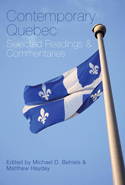
The first is my new edited collection, Contemporary Quebec: Selected Readings and Commentaries, which I co-edited with Michael Behiels at the University of Ottawa. We've been working on this book for the last six years (yikes!) but it's finally in print. It's mainly intended for upper-year Quebec history courses, and contains thirty-one articles and 14 historiographical essays on various facets of Quebec history since the Duplessis era. Several of the articles are new or previously unpublished English translations, and all are situated within the broader literature in the introductory essays to each of the 14 sections of the book. We've also included bibliographies of further readings for each section (with an emphasis on English-language or translated scholarship) to try to assist anglophone undergraduate students doing research on Quebec history. I also have a previously unpublished article in the collection on the interactions between Canadian and Quebec language policies from the 1960s to the early 1980s.

The second publication is
Life After Forty: Official Languages Policy in Canada / Après quarante ans: Les politiques de langue officielle au Canada
. This new edited collection, put together by Jack Jedwab and Rodrigue Landry, came out of a conference held for the 40th anniversary of the Official Languages Act, and includes contributions from a variety of academic and policy perspectives on the impact of this legislation. I have an article in this collection dealing with some of the key features of how this legislation was framed and implemented, particularly its ramifications for the education sector. The book was also the subject of a recent article in the Montreal Gazette.

Christmas presents for the Canadian/Quebec history geeks in your life, perhaps?

Labels: , , ,

Recommend this Post

Monday, November 07, 2011

Official Bilingualism, Officers of Parliament and Supreme Court Justices

Much ink has been spilled of late about the decision of Stephen Harper to appoint a unilingual Supreme Court Justice (Michael Moldaver) and a unilingual Auditor-General (Michael Ferguson) in recent weeks. We've seen the usual range of commentary, which has ranged from demands that all top-level appointments in Canada, including the Supreme Court justices, be bilingual, to calls to have the Official Languages Act substantially watered down and abolished. Over the weekend, I had occasion to participate on a phone-in talk radio show where a caller suggested that Canada's bilingualism policy was responsible for the poor performance of the Montreal Canadiens.

Before turning to my own observations, I'd like to single out two pieces of journalism which have most impressed me. In his piece for Postmedia News, Stephen Maher pointed out that in the case of the Auditor-General, bilingualism was an explicitly listed job qualification, and that it seems particularly egregious to have selected Ferguson when the other three candidates on the short list for the position were all bilingual. In her column this morning, Lysiane Gagnon introduces some important nuance into this discussion, stressing the different job requirements - and talent pools - for the positions of Auditor-General and Supreme Court justice. I largely agree with her column, although her final snipe at the NDP for running candidates who do not speak French rings hollow for me - their constituents should have perhaps been "better employers" before voting for candidates with whom they could not communicate, and thus sending a really mixed message about the importance of bilingualism. But I digress...

My main observations about this issue are as follows. First, there are relatively few positions as an overall proportion of the civil service and judiciary which require full bilingual proficiency. These positions tend to be concentrated in areas where there are high amounts of contact with the public, or in middle-to-senior levels of management where these individuals are expected to manage departments filled with speakers of both official languages. As such, while there have been bitter and vitriolic denunciations of the official languages policy over the past four decades, this is not a complaint for which I have much sympathy in 2011. While I am fully aware that, depending on where in the country one was raised, access to French-language instruction was historically unequal, that situation was largely transformed by the 1980s through funding programs to education. The situation was not perfect, but opportunities did exist. This is particularly true within the federal civil service because, despite decades of calls for the federal government to end its costly language training programs and shift the burden of responsibility for learning a second (or third) language to individuals who sought job promotion, opportunities do still exist within the civil service for keen job climbers to go on language training. Moreover, public service unions have long protected incumbents in positions from suddenly finding their current job in jeopardy from a language re-classification. While I'm sure that someone will point me to some outlier to disprove this general rule, the overwhelming tendency within the public service has been to make bilingualism a condition for career advancement in certain areas - not for maintaining current jobs.

This brings me to the question of which positions actually require bilingualism. Under current job descriptions, the Auditor-General, whose job entails much direct contact with parliamentarians and the media, was listed as requiring bilingualism. The Supreme Court justices, whose work is supported by a small army of interpreters and legal translators, and who have relatively little direct contact with the public or the media, are not currently required to be proficiently bilingual. As such, the cases of Moldaver and Ferguson's appointments must be evaluated differently because of the differences in the currently-stated requirements for those positions. While it might be desirable to appoint fluently bilingual senior jurists to the Supreme Court, there was no requirement that Harper do so (as for the pros and cons of proposals that this be made obligatory, that's ample fodder for a post all of its own). On the other hand, applicants who responded to the search firm contracted to find an auditor general were responding to a position designated as bilingual.

It is this last fact that makes Ferguson's appointment most troubling. I can't help but think that Harper decided to appoint Ferguson even though he didn't meet this job requirement as a trial balloon, testing the public mood about the Official Languages Act. It strikes me that the fact that, on its face, the Auditor-General's job is largely perceived to be about number-crunching, played into the decision to try appointing an individual who did not have French-language capacities. Harper and his advisors may well have been counting on the public to assume that this position was all about financial skills, and ignore the substantial investigation and communication components of this position. How quickly the memory of Sheila Fraser, media star during the AdScam investigations, slipped from the public consciousness! This could well be a test to determine in how many other ways the Official Languages Act and its requirements of the federal public service might be chipped away.

The decision to appoint Ferguson despite the opposition of all three opposition parties is also very discouraging. The Auditor-General is one of a select group of senior public servants who are Officers of Parliament, and as such, stand apart from the regular civil service and rely on the confidence of all of Parliament to conduct their investigations and duties in impartial and non-partisan ways. Selecting an individual who lacked this confidence even at the outset of his appointment will cast a shadow over Ferguson's ten-year term. I should also note that I considered the Liberal tactic of walking out of Parliament in the two votes on this issue to be cowardly and sending precisely the wrong signal to Canadians. In an era where voter participation is on a steep decline, do we really want our politicians, in effect, refusing to cast a ballot because the process was flawed? If our politicians believe that it is important that the Auditor-General be competent in both of Canada's official languages, they should have the courage of their convictions to vote against the appointment of an individual who lacks that qualificiation. If not, they send a signal to Stephen Harper that they too will be wishy-washy when it comes to watering down the Official Languages Act.

Labels: , , , , , ,

Recommend this Post

Wednesday, August 10, 2011

Graham Fraser's So-called Secret Shoppers

Graham Fraser, Canada's commissioner of official languages, has kicked off a bit of a kerfuffle in the nation's capital over a recently announced plan to investigate the state of bilingualism in the national capital region, a research study which would entail both examining signage and service delivery at federal government offices and buildings, but also examining commercial services in the region.

In today's Ottawa Citizen, Fraser defends this study as part and parcel of his mandate, which is not only to be the ombudsman for the federal government's institutional bilingualism, but also to promote and encourage bilingualism in Canada's business and voluntary organizations. He outlines a well-worn path of both his own actions, and those of his immediate predecessor, Dyane Adam. By couching this study as necessary research for identifying best practices in the private sector, he makes a good case for why his office should fund such research. Indeed, had Fraser been alloted more space, he might have pointed out that historically some of the best work of the Commissioner's office has been in areas that are not squarely within the realm of adjudicating complaints about federal bilingualism, but promoting linguistic duality more broadly. Efforts to promote French second language learning and French immersion, which have been ongoing since the first commissioner, Keith Spicer, leap to mind as an example.

It's unfortunate that the media were so quick to attach the phrase "secret shoppers" to this initiative, which invokes images of language police that are, alas, not alien to recent Canadian history. But it would be nice if these secret shoppers were in fact able to discover some great language practices in Ottawa. Then perhaps we could call Fraser "Canada's Secret Santa" if and when he produces a report filled with great new ideas for making bilingual service delivery more widely available. A December report release seems in order, no?

Labels: , , , ,

Recommend this Post

Thursday, July 08, 2010

Plus ça change...

As some followers of our top court are doubtless aware, there is a bill currently making its way into the Senate, initiated by NDP member Yvon Godin, that would require bilingualism of our Supreme Court justices.

So, with that prelude, any guesses as to who said this:

“Competency in the law is, of course, a most important criterion for the appointment of persons to the Supreme Court, but surely in this day and age it should be possible for us in Canada to pick nine men who are not only good lawyers but who are also bilingual. If we cannot do this, or at least aim toward it, there must be something wrong with this country. I do not expect we could have nine bilingual judges overnight but certainly we could work toward this goal.”

Any idea?

Ok, it was a trick question. This particular quote is from Warren Allmand, the Liberal member for Notre-Dame-de-Grace, in 1969 in a debate in the House of Commons about bilingualism on the Supreme Court. The fact that he said "men" and not "individuals" should perhaps have tipped you off.

Overnight, over forty years, over another century perhaps...

Unfortunately, the vehemence of the debate about Godin's bill shows just how poorly certain aspects of Canada's official languages policy have been implemented. The emphasis of the policy has been on providing government and legal services in both official languages. However, in order to really do this effectively and efficiently, you need to have a good-sized cadre of bilingual people to staff these positions, at all levels of government and the legal system, and they need to come from all across the country. Until the resistance of Canadians to learning (or making sure that your children are effectively taught) both official languages starts to break down, these conflicts are going to continue to repeat history, and we'll keep hearing the refrain of "we're not ready yet, but perhaps sometime in the future..."

And now, back to my research notes, as I pore through decades of Hansard reading the parliamentary debates about official languages.

Labels: , ,

Recommend this Post

Thursday, October 22, 2009

Canadian Language Portal

I've been incredibly busy this term, hence the dearth of posts. But my husband, a translator by trade, pointed out this cool new resource to me: Nos Langues/Our Languages is a new language resource tool from the government of Canada. Of particular interest is Termium, which is a major translation database used by the government of Canada, and might be of use to anyone struggling to find that mot juste in their second official language.

Also of interest, speaking of official languages, is the release of volume two of John English's biography of Pierre Elliott Trudeau. Just Watch Me covers the period from 1968-2000. I'm eagerly awaiting the arrival of my copy - the first volume was compelling, and I expect the second one will be as well.

Labels: , ,

Recommend this Post

Wednesday, June 25, 2008

Welcome to James Moore, Secretary of State for Official Languages

Although most of today's attention in the blogging world and news will focus on the more senior members of cabinet moved about in the mini-shuffle, I'd like to draw attention to the only new member, James Moore, the British Columbia MP who today became Secretary of State for the Pacific Gateway, the Olympics and Official Languages - quite the combo!

Moore has long been touted as an up-and-comer in the party, and one whose exclusion from the first several rounds of Harper's cabinet-making was surprising. Or perhaps not, as Moore is also fairly liberal on social questions, being one of the few members of his party to whole-heartedly endorse same-sex marriage. His elevation to a junior position in cabinet could mean a number of different things - that he's out of the doghouse for his liberal views, that the party is worried about his Vancouver seat, or that he's finally being groomed for bigger and better things. In any case, I'll be keeping an ever-closer eye on him now that he's responsible for official languages!

Labels: , ,

Recommend this Post

Tuesday, June 24, 2008

$1.1B for official languages - Breathing a sigh of relief

Back in December, I participated in the Department of Canadian Heritage's stakeholder consultations, facilitated by Bernard Lord, which were held in preparation for a renewal of the government's official languages strategy. The mood in the room was pessimistic, as we had only been asked to participate a few days prior, which gave the impression that the consultations were window dressing, rather than a serious commitment to consultation. There was also widespread concern among the groups present that it would be impossible for the government to hold consultations, write a report, and then develop a strategy in time for when the previous 5-year plan elapsed in March.

Sure enough, the former plan, and existing funding arrangements elapsed in March, and the government was criticized by Official Languages Commissioner Graham Fraser for its inaction on the dossier. Last week (three months later!) I was at a conference on official languages and bilingualism, and there were many sighs of relief at the government's (quiet) announcement that it would be launching another five year plan - a "Roadmap for Linguistic Duality" which committed the government to spending $1.1 billion over the next five years. This does represent an increase in absolute dollars over the previous 5 year plan. There was some criticism in a number of quarters about the fact that the government does not seem to have listened to recommendations that more needs to be done to strengthen official languages teaching and exchange programs in the universities. However, many core programs have been renewed, which is somewhat of a relief! We will have to see exactly how these funds end up being apportioned.

Labels: ,

Recommend this Post

Access to justice partially restored - Court Challenges Revamped and Restricted

You wouldn't know it to read most of Canada's national news media, but the Conservative government partially backtracked last week on its decision to completely axe the Court Challenges Program. This program, initially established under the Liberals to provide funding to groups who wanted to take Charter cases before the courts, was slashed over a year ago. Last week, the government launched a "new" program that will restore funding for groups who are seeking to use the courts to defend linguistic rights either under the Charter of Rights and Freedoms, or other constitutional documents.

I'm pleased for the minority language communities for whom this program's predecessor proved to be such an invaluable tool in securing education rights and other language rights. However, I'm disappointed that the government has decided to be so piecemeal about restoring the program. Other groups that had used the Court Challenges Programs to restore other Charter rights will not have access to a similar program. This may be bad news, for example, for a group like the Little Sisters bookstore, which has been fighting for decades against the inequitable treatment of gay and lesbian publications by Canada Customs.

Labels: , ,

Recommend this Post

Thursday, March 20, 2008

Lord report on official languages

Bernard Lord's report on official languages was released today. At first blush, the big recommendation seems to be urging Ottawa to contribute $1 billion over 5 years to promoting official languages, which represents a substantial increase over the past 5-year plan. I am eager to see the full report, as someone who contributed to the regional forums. I will post more on this as I work through the details.

If you'll permit me one snide remark though, I'm glad that someone from New Brunswick still seems committed to official languages.

Updates:
1. It's remarkable to see how many of the issues raised at my regional forum seem to have been repeated elsewhere in Canada.

2. The focus on the challenges faced by Quebec's anglophone minority is quite interesting - particularly with regards to the "imperfect" bilingualism of young Quebec anglophones, which far outstrips that of their counterparts in the rest of Canada, and yet is a bar to employment in their home province.

3. There is a strong focus on immigrant integtation, and a desire to attract francophone immigrants to other provinces.

4. I like that the theme of Canada developing strength as a leader in "language industries" and "language technologies" was picked up. This really impressed me in my regional forum.

5. Interesting quote: "One of the issues most often mentioned during these consultations has been the need to send a clear message to Canadians about the importance of linguistic duality. Many feel that a discourse based on resistance and the defence of language and culture should be avoided, and that actions should instead be focused on revitalizing linguistic duality and identity, and promoting openness toward other cultures and ways of life. By doing so, the Government would be fostering the development of closer ties between minority anglophone and francophone communities, and between minority communities and the surround majority, particularly in the areas of culture, language and education.

This strikes me as very sound reasoning, and it will be interesting to see what strategies are developed to support this direction.

Labels: ,

Recommend this Post

Friday, December 14, 2007

Fridays with Bernard

Last Friday, I had the pleasure of attending the Toronto meeting of the regional policy consultations on official languages, organized by the Ministry of Canadian Heritage, and chaired by Bernard Lord. It was an interesting group assembled - organizations representing immigrant communities, the business community (particularly language workers), Franco-Ontarian groups, Canadian Parents for French, and a few university professors. About 20 individuals were at the meeting, in addition to the Heritage staffers. For the most part, they were intelligent, well-spoken people who were clearly committed to the continuation and improvement of the government's policies on official languages.

There was certainly some trepidation in the room. The current 5-year plan on official languages is set to wrap up at the end of March 2008, and the people I spoke with expressed concern that with the consultations only happening now, it is unlikely that a new plan will be in place for the start of April - unless these consultations are a sham. There are major concerns about whether funding for official languages is going to dry up while the government works up its next plan. I will say, however, that Bernard Lord appeared to be taking his job seriously. He was clearly engaged with the dossier, asked pertinent questions in response to statements from the participants, and gave no indication that he thought this was not a serious effort. Hopefully this reflects attitudes further up the chain.

I will not go into great detail on the multitude of issues discussed over the course of the day. Certain issues do stand out for me though. There was a widespread call for the federal government to show leadership on this dossier, recognizing that many sectors that touch language are actually under provincial and municipal control. Many participants called for a tri-level approach to language issues, with the federal government serving as convenor.

The recent statistics on second-language learning, and language retention among francophone minorities were of concern to many. One of the most important issues to emerge, in my opinion, was the need for Canada's governments - and this includes the provinces - to work on a new strategy for the promotion of language learning, and communication skills more broadly, as part of the skills needed for the "knowledge economy". Interventions from the business representatives were quite telling - apparently Canada is currently unable to meet the domestic demand for basic language workers such as translators and interpreters, and there is a similar shortage of bilingual and multilingual workers in the private sector. There is a demand for bilingual workers in non-governmental jobs, and this is not part of common discourse on language learning in Canada.

Other issues were new to me - there is clearly a major conflict within francophone minority communities, and in their relation with governments, over the place of immigrant francophones, or immigrants for whom French is not their mother tongue, but preferred official language. Clearly there are integration problems, and also problems in terms of how provincial governments conceive of their responsibilities to provide French-language services to those who are not "de souche" Canadian-born francophones.

I am not sure what unfolded in the other regional meetings, but I was struck (as were some other participants) by the fact that almost all of the people in the meeting were "the converted". 17 of the 20 participants in the room were francophone, and the three anglophones represented either universities or Canadian Parents for French. These consultations need to engage those who do not have quite the same vested interest in official languages, and I hope that these groups and individuals are attending the other sessions. I found the day productive, and I hope that the recommendations from these sessions lead to a reinvestment in official languages, and a more concrete set of policies to promote interpersonal contact between anglophones and francophones, and increased opportunities for second-language learning in a practical context.

Labels: ,

Recommend this Post

Monday, December 03, 2007

Bernard Lord and the Bilingualism Policy Review

Today in Moncton, Stephen Harper appointed former New Brunswick Premier Bernard Lord to head a policy review on the Canadian government's official languages policies. It has been almost five years since the last major policy review produced a 5-year plan entitled The Next Act. Launched by Stephane Dion, it committed the government to a major reinvestment in official languages in order to increase services to official language minorities, and to promote bilingualism among the general Canadian youth population.

Something became clear to me when I read this announcement. On Friday morning, I received an invitation from the Minister of Canadian Heritage to a policy forum on official languages to be held in Toronto this coming Friday. I was wondering why I received such a late invitation to a major policy review - one that required some juggling of my fall exams and meetings. But it would seem that I'm going to get to talk language policy with Bernard Lord, which should prove to be very informative indeed.

Labels: ,

Recommend this Post

Wednesday, July 25, 2007

More news is good news, in both languages

I'm quite pleased by this decision of the CRTC, ordering cable companies to carry both CBC Newsworld and RDI as part of basic cable services. While this is being justified, and rightly so, on the grounds that official language minority communities should have access to news in their own language - it will mean that Franco-Ontarians have access to RDI, for example - I'm thrilled about this as a bilingual news junkie. RDI often provides better coverage of Quebec-based events, including elections and leaders' debates, than the English-language networks do, if they cover them at all.

It also means that viewers can watch political debates and politicians speaking in their original language, rather than through an interpreter, which can be awfully frustrating for bilingual viewers.

Labels: , ,

Recommend this Post

Tuesday, May 08, 2007

A little thing called section 23

I nearly fell off my chair this morning when I read this story that Justin Trudeau had criticized the education system in New Brunswick which has separate systems for anglophones and francophones. Now, I recognize that Justin would only have been about 10 years old when his father fervently fought for the creation of Section 23 of the Charter of Rights and Freedoms, which specifically mandates the protection of official language minority education rights. He might not remember the fact that his father specifically ensured that this section of the Charter could not be overruled by the notwithstanding clause. Maybe he didn't watch the CBC miniseries about his father starring Colm Feore which featured this as a plot point...

He clearly hasn't paid a lick of attention to the past twenty years of activism by French Canadian and Acadian communities that have used this section of the Charter to fight for the right to their own school boards. Perhaps he didn't read about how these communities were upset by the cancellaton of the Court Challenges program, which provided them with financial assistance in their legal battles to have the provinces recognize their educational rights. Perhaps he is unaware that the federal government has spent hundreds of millions of dollars since the 1970s, under the aegis of the Official Languages in Education Program, to help provinces provide official language minority education. Maybe he didn't notice that Stéphane Dion helped relaunch that effort to promote official language acquisition with a major infusion of new federal money in 2003 when he was intergovernmental affairs minister.

I suppose this is one way for Justin to distance himself from criticisms that he's running on his father's name - he clearly doesn't seem to have a great sense of what that legacy implies in francophone minority communities. To be fair, he has apologized for his statements. I rather like the quote from Stéphane Dion in the Globe article: "He is new." It calls to mind a phrase that my friends used to express shock at someone's ignorance or naivete about a subject - "Are you new?!" As one of his first gaffes as a candidate for federal office, this one's a doozy!

Labels: , , ,

Recommend this Post